
Welcome to Post-compulsory Perspectives, the ARPCE Blog – a dynamic space dedicated to sharing insights, research, and reflections on practice in Further Education (FE) and Higher Education (HE). Here, you’ll find regular contributions from our committee members, offering thought-provoking perspectives on the evolving landscape of post-compulsory education. We’ll also feature updates on the latest research developments in FE and HE, alongside guest posts from leading voices in the field. From occasional reflections by our Chair to contributions from practitioners, researchers, and educators, this blog aims to create dialogue, inspire innovation, and strengthen our ARPCE community of practice.

Naming the Work, Mapping the knowledge: how we are developing practitioner research at UCEN Manchester
Francine Warren
March 2026
In everyday educational practice, educators and student services colleagues regularly review and adjust what they do. But what happens if those reviews and adjustments are not incidental, but framed as thoughtful questions, informed by existing knowledge, explored through appropriate methods and used to reimagine practice? In other words, they have moved beyond reflection to enquiry. Often, very little beyond the immediate context. Practice may shift locally, but the knowledge generated is rarely shared more widely.
In the first blog of this series, Kerry Scattergood outlined opportunities for practitioners to share their enquiry funded by the Association for Research in Post-Compulsory Education (ARPCE) last year. Further opportunities have been created this year, with six fully funded places offered at the 6th ARPCE International Conference in July 2026 for educators without access to institutional funding. However, taking up these opportunities requires confidence that your work is of interest beyond your own setting, a significant step if you are unsure whether it counts as research (Scattergood, 2026).
In the past 12 months, two books have been published that focus explicitly on the research of practitioners in education, both identifying practitioner research (PR) as their core focus: Exploring Practitioner Research in Further Education: Sharing Good Practice (Scattergood and Jones, 2025) and The BERA Guide to Practitioner Research (Mawson et al., 2025). Mawson et al. define PR as “a systematic and reflective approach in which professionals integrate research into their practice to enhance their work, inform policy, and improve the experiences of learners, colleagues, and stakeholders” (2025, p.204). These books make clear that such work counts, and that it has a name: Practitioner Research.
Naming the Work
At UCEN Manchester, as in many other institutions, we are moving away from a deficit model of CPD by asking colleagues to identify areas of practice they wish to investigate, and building time into the CPD cycle for collaborative enquiry before sharing their work at the end of the year.
Colleagues work together, sometimes across disciplines, to investigate questions about their practice. Our approach to sharing this work continues to evolve in response to feedback. What began as whole-staff presentations has shifted towards marketplace-style events that prioritise cross-faculty dialogue. Initially called Communities of Practice, these groups are now named Practitioner Research Clusters. When practitioner enquiry remains informal or unnamed, it risks being seen as reflection rather than scholarship. By explicitly naming it Practitioner Research (PR), we make a deliberate claim: this is systematic, knowledge-generating work grounded in professional practice.
Structuring our Practitioner Research Cluster
There is no “right” approach to PR. Both Scattergood and Jones (2025) and Mawson et al (2025) highlight the diversity of the research and researchers featured in their books. However, at UCEN Manchester, we drew on what Saubert and Ziguras (2020) identify as the four key elements that all PR shares to inform our initial understanding:
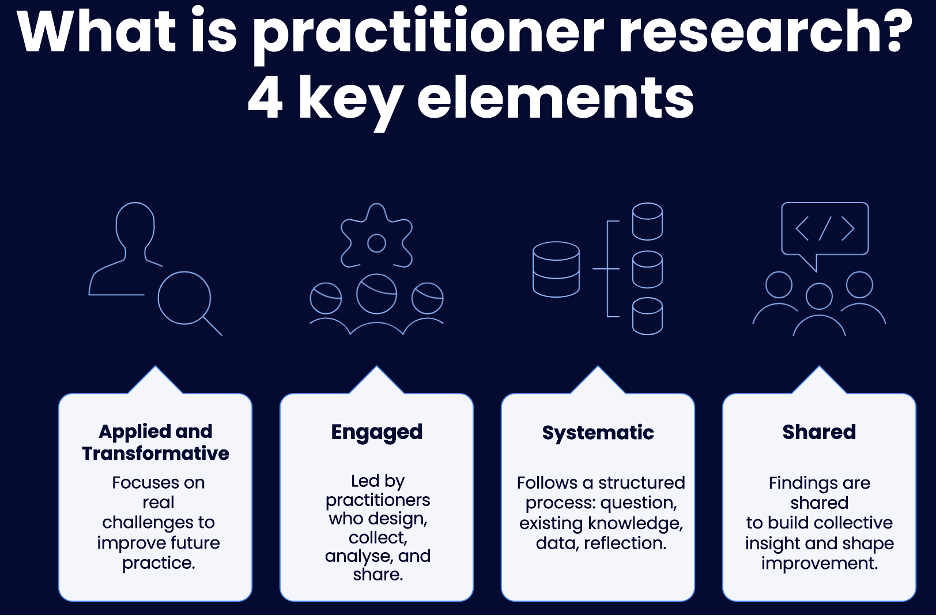
We then adopted a research cycle with guiding questions (Fig 2) to further support colleagues in adopting a systematic approach to their research:
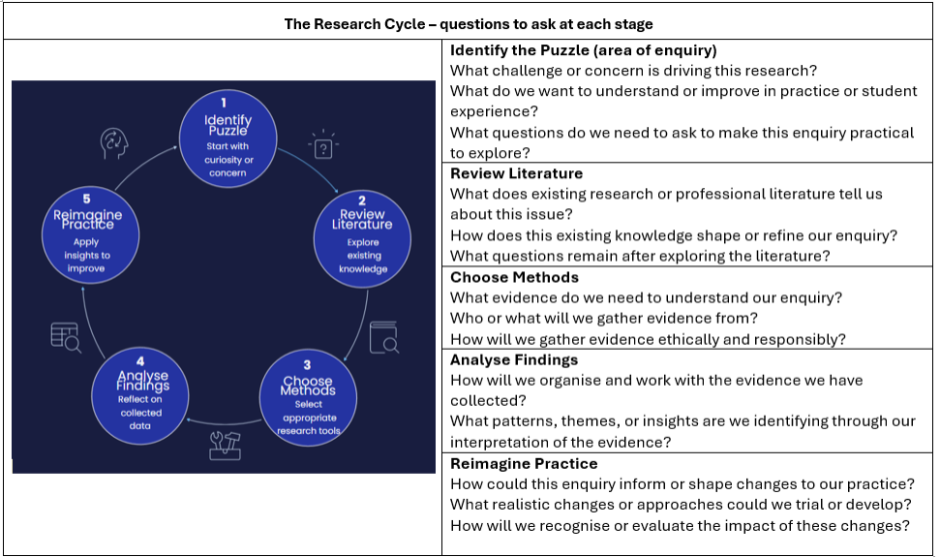
The cycle offers structure without being prescriptive. Practitioner research begins with questions about our own practice, and although much of the learning lies in the process as well as the outcome, when we reimagine practice, we are creating new knowledge.
Mapping the knowledge
In order to stake a claim to the knowledge generated through PR, it needs to be made visible beyond our own institutions. This is happening, but sometimes we need to remind each other of the support and dissemination opportunities available.
As well as the opportunities discussed above from ARPCE, there are organisations who offer support in other ways, for example:
- Through offering their members bursaries for small scale research projects: The Mixed Economy Group (MEG – for college based HE projects. UCEN Manchester has received 3 of their bursaries for PR), the Research College Group (FE and Sixth Form Colleges) and BERA (tend to have a theme each year).
- The ETF-SUNCETT Practitioner Research Programme (Education & Training Foundation and University of Sunderland’s Centre of Excellence in Teacher Training) funds practitioner research programmes at Masters and doctoral level.
- The ETF also funds the Technical Teaching Fellowship (for technical education in FE).
- The Association of Colleges hosts the Think Further blog platform.
- AdvanceHE awards Innovative Practice Grants for college based HE providers to share good practice and iniatives.
Scattergood & Jones (2025) and Mawson et al (2025) write about the desire to “map” PR and encourage other practitioners to share the work they are doing. Maps are both a record of a route travelled and a tool to navigate a future journey. To map the work, it has to be named.
Naming the work is not cosmetic, it is cultural. It signals that practitioner knowledge is legitimate knowledge, and practitioner research does count. When we name the work and share it publicly, we are not only developing practitioner research within our own institutions, we are contributing to a shared map of professional knowledge.
References
Martell, M. M., Carney, M. M., Marin, K. A. & Hashimoto-Martell, E. A. (2021) ‘Whose research counts? Teacher research and the practitioner-academic divide’, The Teacher Educator, 56(4), pp. 399–426.
Mawson, K., Tyson, C.H., Perry, T. and Chen, J.I.H. eds., (2025) The BERA Guide to Practitioner Research: Developing Professional Knowledge in Educational Research and Practice. Emerald Group Publishing.
Saubert, S. & Ziguras, C. (2020) A Guide to Practitioner Research in International Education. Brisbane: International Education Association of Australia & NAFSA.
Scattergood, K. & Jones, S. (eds) (2025) Exploring Practitioner Research in Further Education: Sharing Good Practice. London: Routledge.
Scattergood, K. (2026) Research that counts: practitioner research and sharing practice Blog (Accessed 20/02/2026)
Vygotsky’s ZPD in the Age of Gen-AI
Jen Deakin and Dr. Nasrullah Anwar
February 2026
Vygotsky’s Zone of Proximal Development (ZPD) is a popular theory in pedagogy. ZPD describes the gap between what a person can learn by themselves and what they can achieve with the help of a more knowledgeable other (MKO). Vygotsky (1978, p.38) defines it as ‘the distance between the actual development level as determined by independent problem solving and the level of potential development as determined through problem-solving under adult guidance or in collaboration with more capable peers.’ For Vygotsky, learning is the maturation, or coming-of-age, of development through interaction and cooperation.
An MIT study by Komyna et al. (2025) suggested that over-reliance on Gen-AI tools can cause an atrophying of cognitive abilities, especially when used before engaging our brains to problem solve. Liz Mineo (2025) interviewed several academics for The Harvard Gazette, including Dan Levy, who pointed out that education is not about producing outputs, it is about learning. If using AI hinders learning, then it is no longer a tool, but a crutch that is weakening our ability to think. Using AI itself is not causing cognitive decline, rather how we use it.
Combine these ideas with Vygotsky’s theory and we get a more productive use of Gen-AI tools. If AI as a MKO is only applied upon reaching the extent of our problem solving abilities, our ZPD can extend exponentially without resulting in cognitive decline. It’s like trying a maths problem on paper first, doing the working out and then checking the result with a calculator. The calculator doesn’t replace human thinking, but verifies our findings or enables us to calculate that which is beyond our current ability. This is why we still teach formulas in school instead of handing calculators to learners and stating ‘you no longer need maths’. The same goes for learning to reference, even though there now exists sophisticated referencing tools. However, knowing how to reference is a basic skill for a graduate. Gen-AI should be used thoughtfully, ethically and to enhance our cognitive abilities to achieve that which we were unable to do without it.
The question isn’t whether AI can help learning, but how we can position it as scaffolding rather than substitution. Scaffolding is the contingent, responsive support that enables learners to do what they are not yet able to do alone (Wood, Bruner & Ross, 1976). The danger with Gen-AI is that it can become “non-contingent” support: focusing on answers, and not learner needs. The opportunity is to design its use so that support fades over time and transfers ownership back to the learner.
How can teachers use Gen-AI to extend their ZPD?
Teachers’ ZPD is often constrained by time and other factors. Gen-AI can act as a planning partner after the teacher has done first-pass thinking. Examples include:
- When discussing theory, draft your own explanation first, then ask AI to identify misconceptions learners might have and suggest alternative analogies.
- If you are questioning learners, use AI to generate hinge questions aligned to common misconceptions, then you choose and refine. This links to formative assessment as responsive teaching (Black & Wiliam, 1998).
- To scaffold, ask AI for a sequence of supports that gradually reduce help. This fits cognitive load theory (Sweller, 1988).
- To promote self-assessment amongst learners, use AI to turn success criteria into a short self-check rubric.
Remember this protocol: 1.Think, 2.Plan, 3.Prompt, 4.Verify.
If AI enters before your own thinking, it risks becoming a crutch.
If it enters after, it can expand capacity without hollowing out expertise.
How learners can use Gen-AI to extend their ZPD?
Learners need a routine that keeps them in the productive struggle zone. Bjork & Bjork’s (2010) “desirable difficulties” suggests that when learners forget something and struggle to recall it, they are actually improving their learning of the target concept because such activities trigger encoding and retrieval processes in the memory.
Try teaching them an “AI ladder”:
Attempt independently (2–5 minutes). Write what you know, even if its messy!
Ask for a hint, not an answer. “Give me one clue” / “What’s the next step?”
Ask for a worked example of a similar problem. Then transfer.
Check and explain. “Here is my solution. Spot the error and tell me why it’s wrong.”
Reflect. “What did I misunderstand? What will I do next time?”
Other examples include:
- In essay writing, learners draft a paragraph first, then ask AI to check alignment to the question and identify missing counter-arguments (without rewriting).
- A learner in science explains their reasoning out loud (or in text) and asks AI to point out where explanation becomes descriptive rather than causal.
- A learner practising a skill asks AI to generate a checklist, then compares their performance against it – building self-monitoring and self-regulation (Zimmerman, 2002).
Here AI becomes a scaffold that supports metacognition and gradually hands competence back. This is exactly what ZPD was meant to capture.
References
Bjork, E. L. and Bjork, R., 2011, Making Things Hard on Yourself, but in a Good Way: Creating Desirable Difficulties to Enhance Learning Using Testing to Improve Learning and Memory. In Gernsbacher, M. A., Pew, R. W., Hough, L. M. and Pomerantz Eds), Psychology and the real world: Essays illustrating fundamental contributions to society, New York, NY: Worth Publishers
Black, P. and Wiliam, D., 1998, Inside the Black Box : Raising Standards through Classroom Assessment. Cheltenham, Hawker Brownlow Education.
Kosmyna, N., Hauptmann, E., Yuan, Y. T., Situ, J., Liao, X., Beresnitzky, A. V., Braunstein, I and Maes, P., 2025, Your Brain on ChatGPT: Accumulation of Cognitive Debt when Using an AI Assistant for Essay Writing Task, MIT Media Lab: https://www.media.mit.edu/publications/your-brain-on-chatgpt/
Mineo, L., 2025, Is AI dulling our minds? The Harvard Gazette: https://news.harvard.edu/gazette/story/2025/11/is-ai-dulling-our-minds/
Sweller, J., 1988, “Cognitive Load during Problem Solving: Effects on Learning.” Cognitive Science, 12(2), pp. 257–285, https://doi.org/10.1207/s15516709cog1202_4.
Vygotsky, L., 1978, Interaction Between Learning and Development, in Guavain, M. and Coles, M. (eds) Reading on the Development of Children, New York, NY: Scientific American Books.
Zimmerman, B. J., 2002, “Becoming a Self-Regulated Learner: An Overview.” Theory into Practice, 41(2), pp. 64–70, https://doi.org/10.1207/s15430421tip4102_2.
________________________________________________________
Research that counts: practitioner research and sharing practice
Kerry Scattergood
January 2026
The Association for Research in Post-Compulsory Education’s focus is on post-compulsory education, including adult, further and higher education. Our biennial conference is hosted at Harris Manchester College, University of Oxford, which feels fitting as Harris Manchester is an adult education college. It is an honour to attend Harris Manchester, reflecting ARPCE’s values, but also marks its long history of partnership with further education. In July 2024, the
ARPCE hosted its 5 th international conference at Harris Manchester College, which resulted in a conference-edition of the popular journal, Research in Post-Compulsory Education. It was a fantastic conference with some interesting papers presented, from early-career researchers to experienced academics.
Such events and journals are so important to the scholarship of the post-16 landscape, where academics and practitioners can meet, share research, and challenge what it means to create knowledge in the post-16 sector. However, the ARPCE committee is conscious that the conference and its location, as valuable as we believe it to be, is not always that accessible to some practitioners. We understand the cost can be prohibitive to those practitioners who work in further education colleges and in adult education, and we have tried to be considerate of this in seeking sponsorship and offering bursary places for past conferences. We are also conscious that the traditional ‘conference’ type set up might feel a little intimidating to practitioner researchers taking their first steps presenting their work.
Personally, it took me a while to build up the confidence to share my work, and I know that small-scale writing and presentation opportunities were a part of that journey.
Why are practitioner-focused events important?
Sharing practitioner research in welcoming spaces is important, as it gives practitioners in the post-16 sector the opportunity, time, and space to talk about and think about research in practice. This strikes me as a fundamental pillar of professional learning in post-16 teaching and learning, as it enables a diversity of thought and ideas, and a chance to think through and own our own expertise. However, I think we should be realistic that it is our instinct is to stay with ‘our’ people. It is well recognised that, across the education sectors, people are drawn to likeminded individuals, that “teachers seek answers from other teachers, who do similar work and who understand the practice from similar perspectives” (Martell et al, 2021, p.400). So, creating like-minded, welcoming spaces is important. And without those spaces, if we aren’t able to access more academic spaces, then we are missing out on the opportunity to think together.
Practitioner-focused events
With this in mind, we felt it is important to host some practitioner-focused events, running across the country. These events will follow the research meet approach to ensure they are as accessible as possible: being free to attend, being hosted at accessible locations, and being welcoming by being conscious of the language we use (Jones et al, 2024). Language is so important: it can be used to include people or, conversely, to shut people out. In an attempt to make them as accessible as possible, we planned to run events in different areas, and in June and July 2025 we ran two inaugural ARPCE practitioner research conferences, one in the Midlands at Solihull College & University Centre, and one in the south at Barking & Dagenham College. We are blessed to have colleagues from Scotland and Wales on the committee so, longer term, hope to expand these events to all corners of Britain, to offer opportunities for likeminded individuals to come together to discuss practitioner research and professional learning.
References
Jones, S, Scattergood, K, Ress, J, and Crowther, N. (2024) ‘FEResearchmeet: A further education (FE) practitioner-research-led, initiative to share and develop capacity for research and scholarship across Wales and England: analysing and theorising the period of initial development’, Research in Post-Compulsory Education, pp.428-451.
Martell, M. M., Carney, M. M., Marin, K. A., Hashimoto-Martell, E. A., (2021) ‘Whose research counts? Teacher Research and the Practitioner-Academic Divide’, The Teacher Educator, Vol. 56, No. 4, pp.399-426.